
Bamboo
Rayon vs Bamboo Fabric: 3 Key Differences

Faced with increasingly demanding market needs, apparel manufacturers must not only select fabrics that align with current trends but also carefully consider cost efficiency and sustainability.
To support buyers and brands in making optimal decisions, this article will analyze the differences between rayon vs bamboo fabric. It will also explore whether variations like Bamboo Rayon, Bamboo Viscose, and Bamboo Lyocell offer distinct advantages, ensuring a balance between cost and environmental responsibility.
>>> Read more:
- Modal vs Bamboo Fabric: Making an Informed Choice for Your Clothing
- Evaluating Performance: Bamboo Charcoal Fabric vs. 100% Bamboo Comparison
- Exploring the Textile World: Bamboo vs Hemp Fabric Showdown
- Natural Sleep Solutions: Bamboo vs Linen Sheets Compared
- Bamboo vs Eucalyptus Sheets: Exploring the Differences in Softness
- Eco-friendly or Classic Luxury? Bamboo Sheets vs Egyptian Cotton
1. What is Rayon?
1.1. Definition
In the textile industry, “rayon” can refer to both the material itself and the production process. Additionally, the term “Rayon” is often interchangeable with “Viscose.”
From a material perspective, rayon/viscose is a semi-synthetic fiber made from natural cellulose sources, primarily derived from wood and regenerated agricultural products. Rayon fibers share characteristics with natural silk, offering softness, smoothness, and breathability.
However, when discussing the production process, rayon refers to the method of creating fibers from cellulose. The production process involves several steps, including cellulose treatment, chemical processing, and mechanical procedures to form the fibers. This process can vary significantly, resulting in different types of rayon such as rayon viscose, rayon modal, rayon lyocell, and other variations, depending on the raw materials and technology used.
Rayon fabrics are known for their versatility in shape and texture, often combining properties of other materials like cotton, linen, and silk. However, due to the use of open production technologies, rayon materials can have environmental and health impacts.

1.2. Origins
Rayon (or viscose fabric) was first invented in 1846, but it wasn’t until the 1860s, when the French silk industry faced significant challenges, that scientists began searching for a new substitute material. Louis Pasteur and Count Hilaire de Chardonnet conducted research to create an artificial fiber made from cellulose as a replacement for silk. In 1885, Chardonnet successfully produced this material, laying the foundation for the development of rayon fabric, which ushered in a new era for the textile industry.
By 1911, rayon production had started in the United States, initially referred to as “artificial silk.” It wasn’t until 1925 that the Federal Trade Commission (FTC) officially named this material “Rayon”, categorizing it into two distinct types:
- Rayon: Made from pure cellulose fibers
- Acetate: Made from cellulose derivatives
During the 1950s, rayon became widely used in the production of home decor and interior furnishings. However, by 1955, significant technological advancements improved rayon’s properties, making it more practical and versatile for the fashion and apparel industry.
Since then, rayon has become a popular and cost-effective material, widely utilized in clothing and interior decoration.
Due to its lower production costs compared to closed-loop technologies, factories employing open-loop technology are often located in developing or less-developed countries. However, the open-loop production process for rayon/viscose relies on chemicals that can pose environmental and health risks, potentially harming ecosystems and human well-being.
1.3. The Rayon Production Process

The production process for Rayon/Viscose involves multiple steps. Here is a streamlined description of the key stages:
Cellulose Processing
Pure cellulose is first treated by soaking it in sodium hydroxide to form alkali cellulose sheets. These sheets are then dried, cut into small pieces, and stored in metal barrels for further processing.
Xanthation Process
The cellulose pieces are mixed and stirred with liquid carbon disulfide to form sodium cellulose xanthate pieces. This mixture is then soaked in caustic soda, resulting in a viscous solution. Dyes or color additives may be incorporated at this stage. The solution is then filtered and stored.
Fiber Production
The viscous solution is used to create regenerated cellulose fibers. It is pushed through spinnerets into an acid bath, which solidifies the solution into fibers.
Fiber Spinning
The solidified fibers, after being soaked in acid, are ready to be spun into long strands for weaving. Various spinning methods can be employed, depending on the factory’s technology.
Finishing and Treatment
The spun fibers undergo various treatments and finishing processes, including:
- Chemical treatments
- Weaving processes
- Additional steps to enhance performance properties, such as anti-shrinkage, wrinkle resistance, fireproofing, water repellency, and smoothness control.
Adaptation to Environmental Trends
These steps represent a simplified version of the Rayon/Viscose production process, but variations can occur depending on the specific type of rayon and factory procedures.
However, with consumer preferences shifting toward eco-friendly products, along with the fashion industry’s commitment to circular economy goals and Net Zero initiatives, the use of open-loop production technologies like rayon/viscose is increasingly being restricted. Instead, companies are focusing on developing closed-loop or mechanical technologies, which aim to reuse and conserve resources, meeting the market’s sustainability requirements.
2. Rayon vs Bamboo Fabric

Rayon and Bamboo fabric are two distinct materials with different origins and properties.
Rayon is made from cellulose derived from wood (such as oak trees) through a complex chemical process.
Bamboo fabric, on the other hand, is also considered a semi-synthetic material sourced from natural bamboo plants. It can be produced using both open-loop and closed-loop technologies, resulting in two variations of bamboo fabric with distinct features and environmental impacts.
Understanding the differences between Rayon and Bamboo fabric is crucial for making informed decisions when placing bulk orders for textile manufacturing.
2.1. Characteristics and Properties
Rayon:
- Soft and smooth texture
- Good moisture absorption and breathability
- Elastic properties
Bamboo fabric:
- Also offers a soft and smooth feel
- Superior antibacterial properties
- Excellent sweat absorption
- Notably high UV protection capabilities
2.2. Production Process
The Rayon production process requires a complex combination of chemical treatments and technology to convert natural cellulose sources into fabric fibers.
In contrast, bamboo is known as a fast-growing plant that requires less water, fewer pesticides, and minimal fertilizer during cultivation. Bamboo fabric is typically produced using mechanical processing or solvent-based treatments.
Environmental Impact and Sustainability Goals
Bamboo fabric is highly regarded for its natural origin, which aligns with sustainable development goals. However, the open-loop production processes, like viscose, still pose significant environmental challenges. It is only when bamboo is produced using closed-loop technology that the material can ensure optimal eco-friendliness and consumer health safety, meeting modern sustainability standards.
2.3. Applications and Uses in Various Products
Both Rayon and Bamboo fabric are widely used in the fashion industry and household product manufacturing.
Rayon is commonly found in:
- Upholstery production
- Affordable fashion clothing, such as dresses and tops
Bamboo fabric, on the other hand, is often used in:
- Underwear production
- Activewear and sportswear
- Casual everyday clothing
Understanding the distinct characteristics, production processes, and applications of these two fabrics enables consumers and businesses to choose materials that best suit their specific needs and preferences.
3. Classification of Bamboo Rayon, Bamboo Viscose, and Bamboo Lyocell
3.1. What is Bamboo Rayon?

Rayon is a semi-synthetic fiber made from plant-based materials like wood. However, it’s important to note that the term “Rayon” is a general term used to describe this type of fiber and can be made from various types of trees.
To combine the benefits of both Rayon and Bamboo, manufacturers often blend these materials to create products that offer multiple advantages while remaining more cost-effective than 100% mechanically-produced bamboo fabric.
If you come across terms like “bamboo rayon” or “rayon from bamboo,” it refers to a type of rayon fiber produced from bamboo pulp processed using Rayon/Viscose technology.
Note: This bamboo rayon fabric often contains a mix of wood pulp from different sources, rather than being made solely from 100% bamboo material. Therefore, thorough testing and certification are necessary to ensure the safety and eco-friendliness of these products for consumers.
3.2. Bamboo Viscose

Bamboo rayon and bamboo viscose are often used interchangeably, but they are not the same. Bamboo rayon is made from cellulose, while bamboo viscose is produced from pulp. Although the production processes are quite similar, they use slightly different solvents.
Bamboo viscose has a feel similar to cotton, but its appearance resembles silk and has a good wrinkle-resistant property. Additionally, it offers breathability and anti-static features.
Note: Bamboo viscose is often a point of debate due to the use of open-loop technology or blending with other wood pulps, which results in a lower cost but does not guarantee that the fabric is made solely from 100% bamboo material. To ensure consumer safety, certifications and strict quality checks are necessary regarding the material’s source and production methods.
3.3. Bamboo Lyocell – Closed-Loop Technology
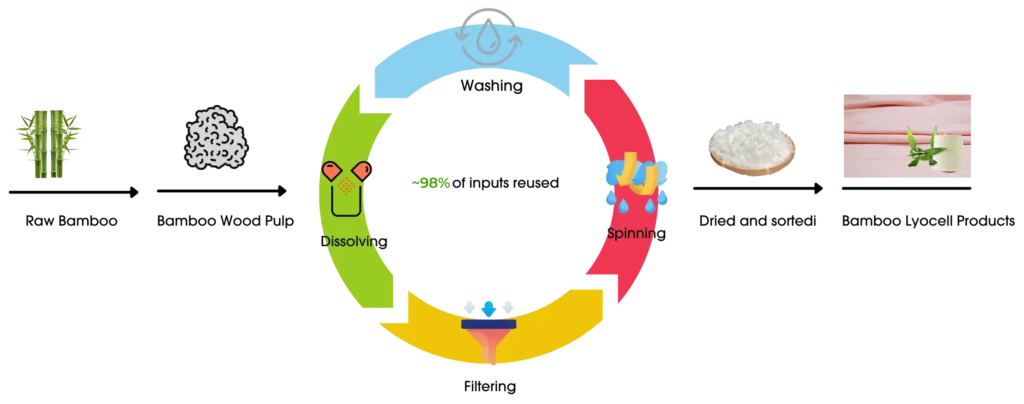

Bamboo Lyocell is another type of bamboo fabric produced from cellulose using a closed-loop technology. However, the Lyocell process (creating bamboo fibers for spinning) differs slightly from other methods.
Modern Lyocell production methods use less energy and are more environmentally friendly because they recycle solvents and materials in a closed-loop process. In this method, bamboo pulp is broken down to form Lyocell fibers, with approximately 98% of solvents and water recovered and reused in subsequent production cycles, significantly reducing water consumption. This process is more eco-friendly compared to open-loop technologies.
W.ELL Fabric recommends manufacturers in the textile industry to prioritize bamboo fabrics made with closed-loop technologies like Lyocell, ensuring a clear origin. This approach optimizes resource reuse, minimizes ecological impact, and aligns with global textile trade agreements, facilitating smoother exports.
Moreover, closed-loop technology delivers high-quality fabrics with superior softness and safety for consumers, making it an ideal choice for sustainable production.
3.4. 100% Bamboo
When a label states 100% bamboo fabric, it means that the product is made entirely from bamboo material, without any blending with other fabrics. It uses only 100% bamboo fibers during the production process to create a natural bamboo fabric. These products do not contain cotton, polyester, or any other materials.

However, in some cases, if the label claims 100% bamboo, it may actually mean that the product contains 95% bamboo fibers and 5% spandex, which is added to provide elasticity and stretch. Despite the inclusion of spandex, the majority percentage of bamboo ensures that the product maintains its natural properties and high quality.
>>> Read more: Bamboo vs Silk Sheets: Examining the Benefits and Considerations
4. Which Bamboo Fabric is Best and Most Eco-Friendly?
In terms of quality and user experience, bamboo rayon and bamboo viscose don’t have significant differences, as both offer a similar feel and performance. However, bamboo lyocell is considered the highest-quality bamboo fabric, with superior benefits in durability and sustainability.
To choose high-quality bamboo fabric, businesses should pay attention to the following factors:
- Raw Material Source: Verify the origin of the materials and whether the supplier can provide a Certificate of Origin (CO).
- International Certifications: Check if the products have obtained any recognized international certifications.
- Production Technology: Determine whether the production process uses an open or closed-loop technology, and whether the fabric’s key properties have been certified by relevant authorities.
- Manufacturing Country: The location where the fabric is produced can also impact import taxes, which can help optimize production costs.
W.ELL Fabric is currently producing and supplying high-quality Bamboo Biocell fabric made in Vietnam:
– With a clear origin and traceable product information, we provide CO (Certificate of Origin), enabling businesses to benefit from import tax advantages and quotas as more countries open their markets to Vietnam.
– Our fibers are made from natural bamboo, rich in cellulose, sourced from the lush, native bamboo forests of Sichuan, China, spanning up to 12,000 hectares.
– By using a closed-loop production process, we preserve the valuable properties of bamboo, reusing 98% of compounds during the fiber production process—an eco-friendly model that minimizes waste and environmental impact.
– Key features of Bamboo Biocell fabric:
- Odor control and antibacterial properties
- Flexible thermal management
- Quick-drying, minimal shedding
- UV protection with a UPF 50+
– Our products meet various green certifications, including GOTS, GRS, and Oeko-Tex 100.
– We offer a wide range of weaving options (woven, knit) and material combinations (cotton, modal, recycled fibers, etc.) to suit diverse applications across industries.
– With flexible MOQ options, we can meet various production needs.
Bamboo Biocell was developed in response to the global textile industry’s challenges during the Covid-19 pandemic. It is a pioneering fabric line made in Vietnam, ensuring strict control from the sourcing of natural bamboo fibers to the weaving and finishing technologies.
Contact us for detailed consultation:
Hotline: +84857902535
Email: hello@wellfabric.com.
—
>>> Read more: Is Bamboo Fabric Good? Debunking Myths About Bamboo Textiles?


Wow, no more than 100 harmful substances for human health are found in the products! That really makes me feel safe!!!